THE EVIDENCE
It lands better than you expect
Letter writers underestimated how happy and surprised their readers would be, across four experiments.
See the studies doodlegreeting
WHAT THE RESEARCH SAYS
Your card will probably mean more than you think.
WRITE it today
Warmth over wording What letter writers got wrong
People who write notes of thanks consistently underestimate how surprised and pleased the reader will be, and worry far too much about getting the words right. Here is what the evidence says about writing a card that lands, in plain English.
Plain English, with the sources linked.
THE SHORT ANSWER
Card writers fret about the words.
Readers mostly notice the gesture.
THE EVIDENCE
Letter writers underestimated how happy and surprised their readers would be, across four experiments.
See the studiesTHE CRAFT
Name one thing they did or one shared moment, and say why it mattered. That is the whole trick.
Try the card helperTHE HISTORY
Cheap post from 1840 and the first printed Christmas card in 1843 turned greetings into a national habit.
Five card factsA QUICK CARD HELPER
Pick the occasion. You will get one simple rule for the message, drawn from what the gratitude research found readers actually value.
These are writing prompts, not rules. A short honest line in your own words beats any formula.
WRITE ONE TODAY
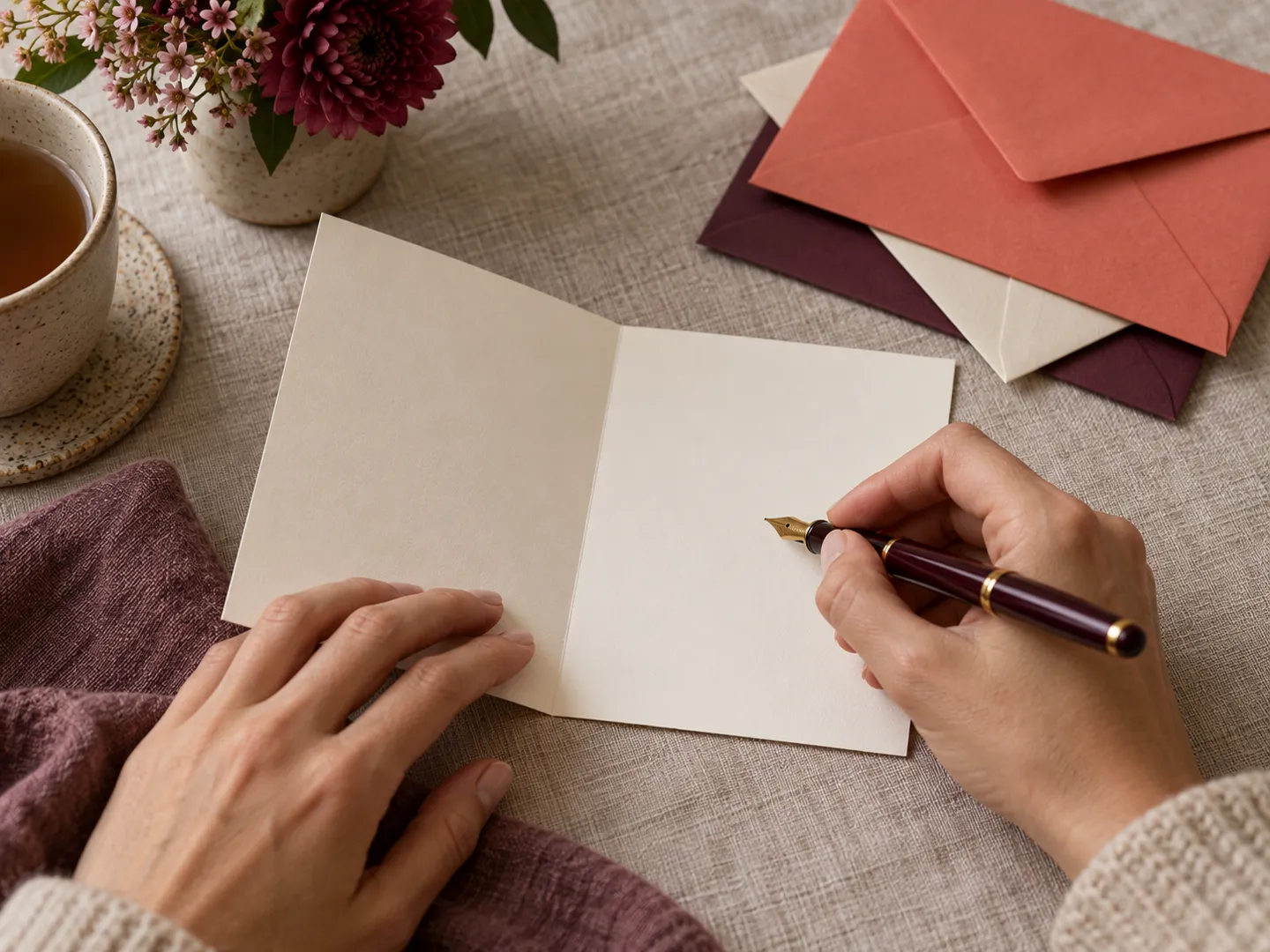
A moment, a favour, a phrase they said. Name it plainly, then say what it meant to you.
Berkeley’s Greater Good Science Center suggests about 10 minutes for a gratitude letter. A card needs no longer.
Readers valued the warmth of the gesture far more than skilful wording. Spelling slips are forgiven.
Plain paper and card without glitter is easier to recycle. Check your council’s guidance for anything with foil or attachments.
TWO STUDIES WORTH KNOWING
The note that feels awkward to write
is often the one that is welcomed most.
Warmth over wording
What letter writers got wrong
In four experiments, people wrote a letter of gratitude to someone who had affected their life. They underestimated how surprised and positive the recipients would feel, overestimated how awkward it would be, and worried too much about wording.
SAYING THANKS · 2018
1 month later
Five exercises compared
In a test of five positive psychology exercises, writing and delivering a gratitude letter gave the greatest boost to happiness one month later. By six months the effect had faded, so it is worth repeating.
THE GRATITUDE LETTER · 2005
Neither study is about cards as such, but both point the same way: a short, specific note of appreciation is cheap to write and tends to be valued more than the writer expects.
CARD FACTS
Uniform Penny Postage began in Britain on 10 January 1840. A penny now sent a letter weighing up to half an ounce, just over 14g, anywhere in the country.
According to The Postal Museum, by 1850, a decade after the Penny Black, people in Britain were sending 347 million letters a year.
In 1843 Henry Cole had a thousand copies of a card by the artist John Callcott Horsley printed. At a shilling each they were expensive, and the V&A calls the venture a commercial failure.
The V&A holds over 30,000 greetings cards, more than half of them for Christmas. One of Cole’s original cards sold at auction in 2013 for £22,000.
West Sussex County Council advises that cards and paper covered in glitter cannot be recycled because of the particles, and should go in general waste.
QUICK QUESTIONS
Short answers to the questions people ask most.
Research suggests it means more than senders expect. In four experiments published in 2018, people who wrote letters of gratitude underestimated how surprised and positive the recipients would feel, and overestimated how awkward they would find it.
Be specific. Name one thing the person did or one shared moment, and say why it mattered to you. The 2018 research found recipients valued the warmth of the message far more than how skilfully it was worded.
Not long. The Greater Good Science Center at UC Berkeley suggests budgeting about 10 minutes to write one, and one of the 2018 researchers noted that such letters take only a couple of minutes to compose.
The V&A credits its founding director, Henry Cole, with sending the first Christmas card in 1843. He had a thousand copies printed from a design by the artist John Callcott Horsley, and sold them for a shilling each.
Plain paper cards usually can, but many councils, including West Sussex, say cards covered in glitter cannot be recycled and should go in general waste. Rules vary, so check your own council’s guidance.
Updated
A NAME WORTH SENDING
doodlegreeting.com is part of the DoodleSale portfolio. It isn't in an auction right now, but you can ask about leasing it.